
OP-ED: Genius Archives by Brie Alexander
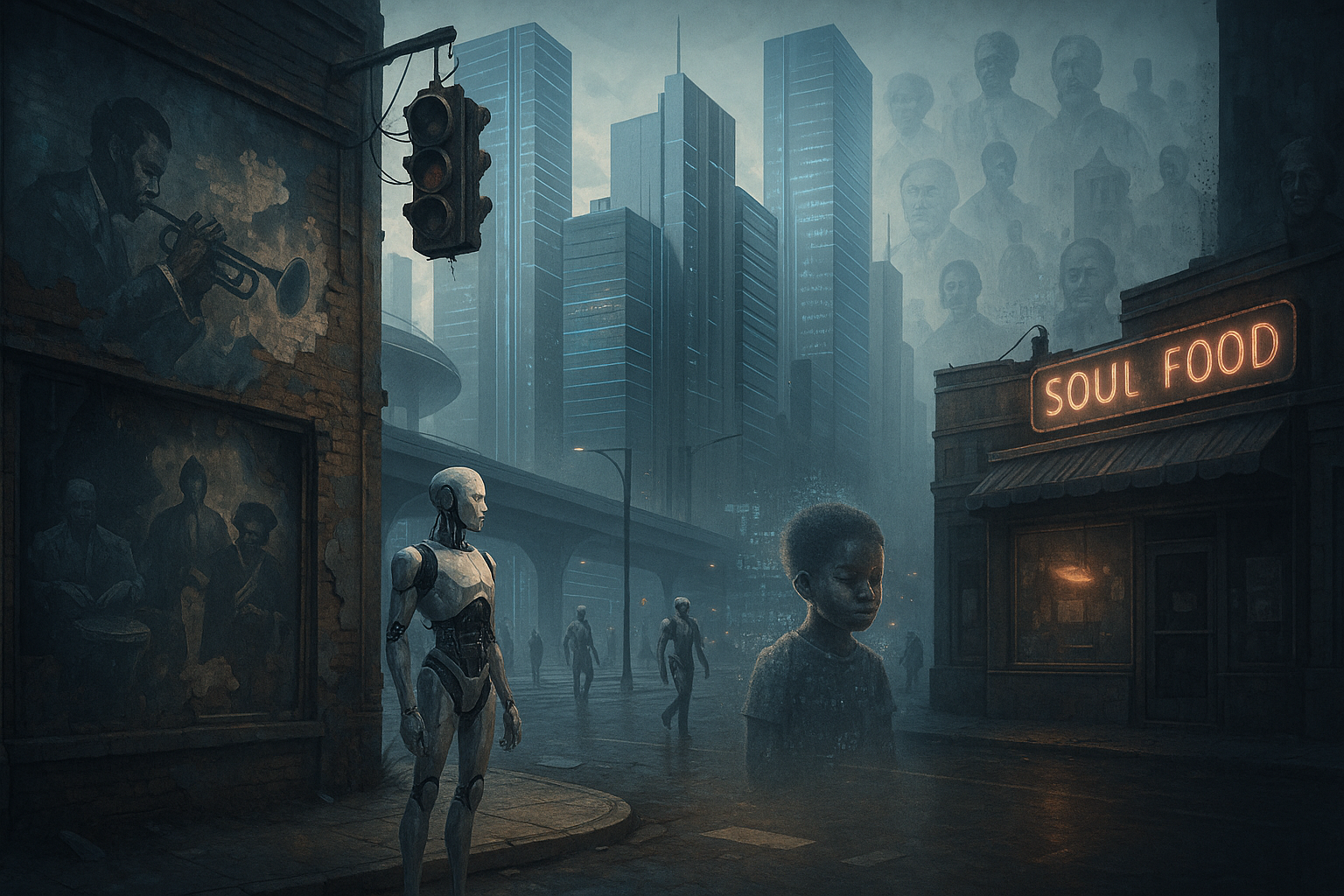
This is the first in a new column tracing the global footprints of empire in its modern forms—from cobalt mines to cloud servers, from disappearing villages to data centers on stolen land. Here,we name what others redact. We celebrate the brilliance empire tries to erase.Because genius is not a gift we seek. It is memory’s sharpest weapon.
The Cost of Intelligence: AI’s Energy Appetite Is Staggering
Training a large AI model can consume more electricity than 100 U.S. homes use in a year
(International Energy Agency, 2024). Inference—the process of running AI models—requires
even more as usage scales.
According to the IEA, global data center electricity consumption is expected to double by 2030,
with AI being the leading cause. In the U.S., AI data centers are projected to account for nearly
50% of electricity demand growth over the next five years. By 2028, they may consume up to
12% of all U.S. electricity (IEA, 2024).
Each AI rack can draw 50–100kW, five times more than traditional servers, requiring massive
cooling systems—often powered by methane gas turbines. In many areas, these backup
plants operate 24/7, placed directly beside homes in poor and often Black neighborhoods.
Location, Location, Exploitation: 9 out of 10 Data Centers Target
Marginalized Communities
A 2025 study by the Energy Justice Network found that 9 of the 10 counties most impacted
by new AI data center projects are poor, predominantly Black, or rural communities already
suffering from environmental burdens.
In South Memphis, Tennessee, Elon Musk’s xAI project, dubbed “Colossus,” runs on at least
35 methane turbines with no Clean Air Act permits or pollution controls (ProPublica, 2025). It
emits 1,200 to 2,000 tons of nitrogen oxides annually, worsening already high asthma and
cancer rates (Wasteland Documentary, 2024).
Meanwhile, Meta’s AI campuses in northeast Louisiana and Newton County, Georgia, have
raised red flags about water access, rising utility bills, and long-term environmental risks. In
South Carolina, Meta and Google pledged $4B for new data centers—again, in regions with
little regulation and high vulnerability.
The False Promise of “Tech Jobs” in the Age of AI
Modern AI data centers require minimal staffing. A $10B campus might employ only 100–200
people, most of them highly skilled and recruited from elsewhere. Local Black residents are
rarely hired for long-term roles.
Worse still, the very technology inside these centers is designed to automate the sectors
where Black workers are overrepresented—from transportation and retail to basic healthcare
and customer service. A report by the Brookings Institution (2023) warns that up to 44% of jobs held by Black Americans are at high risk of automation. Without meaningful policy shifts, these
communities face economic displacement alongside environmental degradation.
The Capitalist Delay
Much of this automation tech has existed for over a decade. So why wasn’t it deployed sooner?
Because for years, economists asked: “If we automate the workforce, who buys the products?”
For a time, Universal Basic Income was proposed—not out of equity, but as a buffer to
maintain consumer capitalism. But when that proved politically risky, the strategy changed.
Rather than support displaced people, the system turned to behavioral surveillance,
predictive policing, and data-driven control. Poverty would be tolerated. Resistance would
be managed.
This wasn’t innovation delayed. It was disruption deferred—until resistance had been
defanged and power could restructure itself in peace. And for Black communities? The delay wasn’t protection. It was the setup. While We Choke, China Cools Its AI With Oceans
In contrast, China has begun placing its AI data centers underwater. Pilot facilities near Hainan use the ocean’s natural cold temperatures to reduce energy use by up to 40%, eliminating the need for land-based cooling systems or air-polluting generators (South China Morning Post, 2024; China Daily, 2025).
While the U.S. puts AI facilities in South Memphis,
China puts them under the sea.
While Black Americans breathe nitrogen oxides, Chinese servers breathe seawater.
This isn’t about technological capacity. It’s about consent, ethics, and who gets sacrificed for
progress.
A Modern Algorithm for Old Exploitation. Elon Musk’s public image sells electric cars, Mars missions, and “freedom-first” AI. But in practice, his companies echo the tactics of empire:
● Tesla’s Fremont plant was cited multiple times for pollution (EPA, 2023)
● SpaceX’s Starbase launched debris across Indigenous lands in South Texas
● xAI’s Colossus poisons the lungs of South Memphis children in silence
According to the American Lung Association (2024), Memphis now ranks among the top 25
U.S. cities for year-round particle pollution. The CDC confirms that long-term exposure to PM2.5 contributes to asthma, cognitive decline, cardiovascular disease, and birth complications. Meanwhile, Black Americans are exposed to 56% more air pollution than they create, while white Americans are exposed to 17% less (PLOS One, 2019).
That’s not disparity. That’s data-driven genocide.
From Greenwood to Grok: Innovation Built on Erasure.
In 1921, white mobs burned down Tulsa’s Greenwood District—Black Wall Street—in a state-
sanctioned massacre. Over 1,200 Black-owned homes and businesses were destroyed.
Today, the erasure is subtler, but just as systemic. Instead of bombs, there are gas turbines.
Instead of mobs, there are LLCs. Instead of fire, there’s policy. The United Nations definition of genocide includes “inflicting conditions of life calculated to bring about a group’s physical destruction in whole or in part.” If that’s not what’s happening in South Memphis, in Cancer Alley, in Flint—what is?
The U.S. Is the Staging Ground What’s happening now isn’t collapse—it’s a controlled burn.
Tariffs are tightening.
Jobs are vanishing.
Corporations are fleeing.
Labor is being replaced.
The U.S. is becoming a test lab for a new system:
● Automation without employment
● Surveillance without consent
● Pollution without resistance
● Profit without people
This isn’t the end of capitalism. It’s its upgrade.
And what happens in Memphis doesn’t stay there. It becomes the blueprint—for Lagos. São
Paulo. Manila. Johannesburg.
Closing Reflection
In the world they’re building, we are either deleted or disposable. We’re watching the future
get coded without us in it—in real time. This isn’t science fiction. It’s source code.
And unless we reclaim the pen, we don’t make it to the sequel.
About the Author
Brie Alexander is a Pan-African writer and cultural strategist whose work fuses celebration with
truth-telling. Through sharp critique and deep cultural reverence, she spotlights African brilliance
while exposing the global systems—economic, environmental, and algorithmic—that seek to
erase it. In her column, Genius Archives, she bridges renaissance -recovering the voices, memories, and futures of African visionaries across the globe.
References
● International Energy Agency. (2024). Electricity 2024 Report.
● American Lung Association. (2024). State of the Air Report.
● Centers for Disease Control and Prevention (CDC). (2023). Health Effects of PM2.5
Exposure.
● Energy Justice Network. (2025). Data Center Siting and Environmental Impact.
● ProPublica. (2025). Inside xAI’s Colossus: How One AI Project Pollutes Memphis.
● Wasteland. (2024). Directed by Ava DuVernay. Documentary Film.
● Brookings Institution. (2023). Race and the Risks of Automation.
● South China Morning Post. (2024). China Tests First Ocean-Based Data Center.
● China Daily. (2025). Green Cooling for Smart Infrastructure.
● PLOS One. (2019). Disparities in Air Pollution Exposure in the United States.
● EPA Enforcement Reports. (2023). Tesla Fremont Facility Violation Summary.
● United Nations. (1948; reaffirmed 2022). Convention on the Prevention and Punishment
of the Crime of Genocide.
● Tulsa Race Massacre Commission. (2021). Final Report: Tulsa 1921.
